
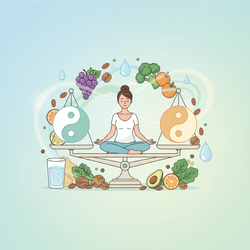
Balancing Your Hormones
Posted by The Sarvaa Team on 13th Feb 2026
Stress, Blood Sugar, and Adaptogens
Hormones are the master messengers of your body.
Hormones help coordinate energy, mood, sleep, appetite, metabolism, and your stress response—often through beautifully designed “feedback loops” between glands and tissues.
When those loops are supported, your body tends to feel steadier. When they’re overwhelmed (hello, modern life), you might notice more swings—energy crashes, restless sleep, cravings, irritability, or that feeling of being “off.”
Some everyday chemicals can also interfere with hormone signaling—one more reason we keep coming back to simple, supportive choices.¹
How Hormone Communication Works
Think “call and response.”
A gland releases a hormone (a message). Another tissue receives it (the response). Then your body “checks the signal” and adjusts—up or down—so you stay in balance.
When inputs like chronic stress, inconsistent sleep, blood sugar spikes, or environmental exposures stack up, the signaling can get noisy. The goal isn’t perfection—it’s support: fewer spikes, more steadiness, more recovery.
Your Daily Rhythm Matters
Ayurveda’s reminder: you are not separate from nature.
Ayurveda teaches that what happens outside of us is reflected within us—light and dark, activity and rest, seasons and cycles. That’s why sleep, movement, and food quality belong in the same conversation.
Here’s a simple Sarvaa rhythm to try (starting tonight):
- Get morning light (even 5 minutes outside)
- Choose gentle daily movement (walks count—especially after meals)
- Build a steadier plate (protein + fiber + healthy fats with carbs)
- Create an earlier wind-down (nervous system calm is hormone support)
Endocrine Disruptors
A gentle “swap list” that can make a real difference over time.
We can’t control everything in our environment. But we can reduce a few common sources—without fear, without overwhelm. Think of this as a “do what you can” list, not a “do it all” list.
1. Fragrance and personal care extras
Many personal care products contain ingredients that are actively studied for hormone-disrupting potential—especially when labels include “fragrance,” which can hide multiple chemicals.¹,²
Try this:
- Choose fragrance-free (not just “unscented”) when possible
- Look for paraben-free and phthalate-free labels²
- Keep it simple: fewer products, fewer exposures
2. Scented candles and indoor air
Indoor burning can add to your total “chemical load,” especially in small or poorly ventilated spaces.³
Try this:
- Ventilate (crack a window) when using candles
- Choose candles without added fragrance when possible
- Consider a gentle alternative (like airing out your home or simmering citrus peels and spices)
3. Plastics, linings, and “hot food + plastic”
Some plastics-related chemicals (including certain bisphenols) are discussed by health agencies as endocrine disruptors because they may interfere with hormone signaling.¹
Try this:
- Don’t microwave or pour hot liquids into plastic
- Use glass or stainless steel for water and hot drinks
- Reduce single-use plastics where you can
4. Produce, pesticides, and “do your best” choices
Pesticide exposure is an active research area. One review looking at glyphosate-related epidemiology discusses how study design, exposure level, and quality affect conclusions—and why this topic stays complex.⁴
Try this (without perfectionism):
- Wash and scrub produce well
- Prioritize organic where it matters most to you (or where you eat it most often)
- Consider frozen organic fruits/veggies as a budget-friendly option
5. Nanoplastics (emerging research)
This is still developing science, but researchers are exploring how nanoplastics may affect different body systems in experimental settings.⁵
Try this:
- Reduce single-use plastic bottles when possible
- Use a refillable bottle (glass or stainless)
- Store food in glass containers when you can
How Sarvaa Suggests You Nourish Your Endocrine System
Food first, rhythm always.
Beyond avoidance, we love the “yes” side of this conversation: nourishing inputs that help your body feel supported.
In Ayurveda and traditional herbal practice, certain plants are commonly used to support resilience and daily rhythm—especially during stressful seasons. For many people, these are gentle allies within a bigger lifestyle foundation (steady meals, daily movement, real sleep).
Some favorites often used in wellness routines include:
- Ashwagandha (traditional adaptogen support)
- Tulsi / Holy Basil (traditional calm-and-clarity support)
- Maca (traditional vitality support)
- Dandelion leaf (traditional digestive support)
We created these formulas as simple tools you can build around your day:
- Hormone Happiness → daily nourishment + rhythm support
- Radiant Recovery → recovery support for digestion, balance, and replenishment
- Adrenal Assist → steady support during high-demand seasons
- SupraGreens → foundational daily nutrition to help you feel grounded and consistent
Want to learn more?
If you’d like a simple, friendly walkthrough of hormones and the endocrine system: Read the Endocrine Guide
Gentle Reminder
You don’t have to do all of this at once.
Pick one change that feels kind to your life right now:
- Swap one personal care item
- Walk after one meal per day
- Move your water bottle to glass
- Choose one earlier bedtime per week
That’s Sarvaa: To Nourish. To Heal. To Transform. One steady step at a time.
Love your body. Love everybody!
Disclaimer
Insights are based on nutritional science, naturopathic principles, Ayurveda, and traditional herbal practice. Ingredient benefits reflect historical use and modern research on nutritional composition. Educational use only. This information is not medical advice and is not intended to diagnose, treat, cure, or prevent any disease. Statements have not been evaluated by the FDA.
Footnotes
- National Institute of Environmental Health Sciences, Endocrine Disruptors and Your Health (fact sheet), accessed February 10, 2026, https://www.niehs.nih.gov/sites/default/files/health/materials/endocrine_disruptors_508.pdf.
- Abdullah M. Alnuqaydan, “The Dark Side of Beauty: An In-Depth Analysis of the Health Hazards and Toxicological Impact of Synthetic Cosmetics and Personal Care Products,” Frontiers in Public Health 12 (August 26, 2024): 1439027, https://doi.org/10.3389/fpubh.2024.1439027.
- Zainab Nazir, Ashna Habib, Tooba Ali, Hafsa Ghouri, and Md Ariful Haque, “The Unknown Risks of Scented Candles! What Science Has to Say: An Editorial,” Annals of Medicine and Surgery 86, no. 1 (January 2024): 16–17, https://doi.org/10.1097/MS9.0000000000001524.
- John Acquavella, “Epidemiologic Studies of Glyphosate and Non-Hodgkin’s Lymphoma: A Review with Consideration of Exposure Frequency, Systemic Dose, and Study Quality,” Global Epidemiology 5 (February 25, 2023): 100101, https://doi.org/10.1016/j.gloepi.2023.100101.
- P. A. I. Setiyowati, F. Saputra, F. R. P. Dewi, M. A. Herdiansyah, V. Lim, and A. Hayati, “Metabolic-Endocrine Remodelling of the Testis under Polystyrene Nanoplastic Exposure: Intervention by Organ-Specific Phytocomplexes of Nelumbo nucifera,” Reproductive Biology 26, no. 2 (February 7, 2026): 101183, https://doi.org/10.1016/j.repbio.2026.101183.