
Amla berry benefits are rooted in the fruit’s unusual combination of vitamin C, polyphenols, and a long history in Ayurvedic food and herbal traditions. Also known as amalaki or Indian gooseberry, Phyllanthus emblica is intensely sour and is used fresh, dried, powdered, juiced, and in traditional preparations such as Chyawanprash and Triphala.
One important detail is that published vitamin C values for amla vary widely depending on the fruit and the testing method. Rather than treating a single number as universal, this article looks at amla’s broader nutritional profile, Ayurvedic context, current research, and practical daily use.
What Is Amla Berry?
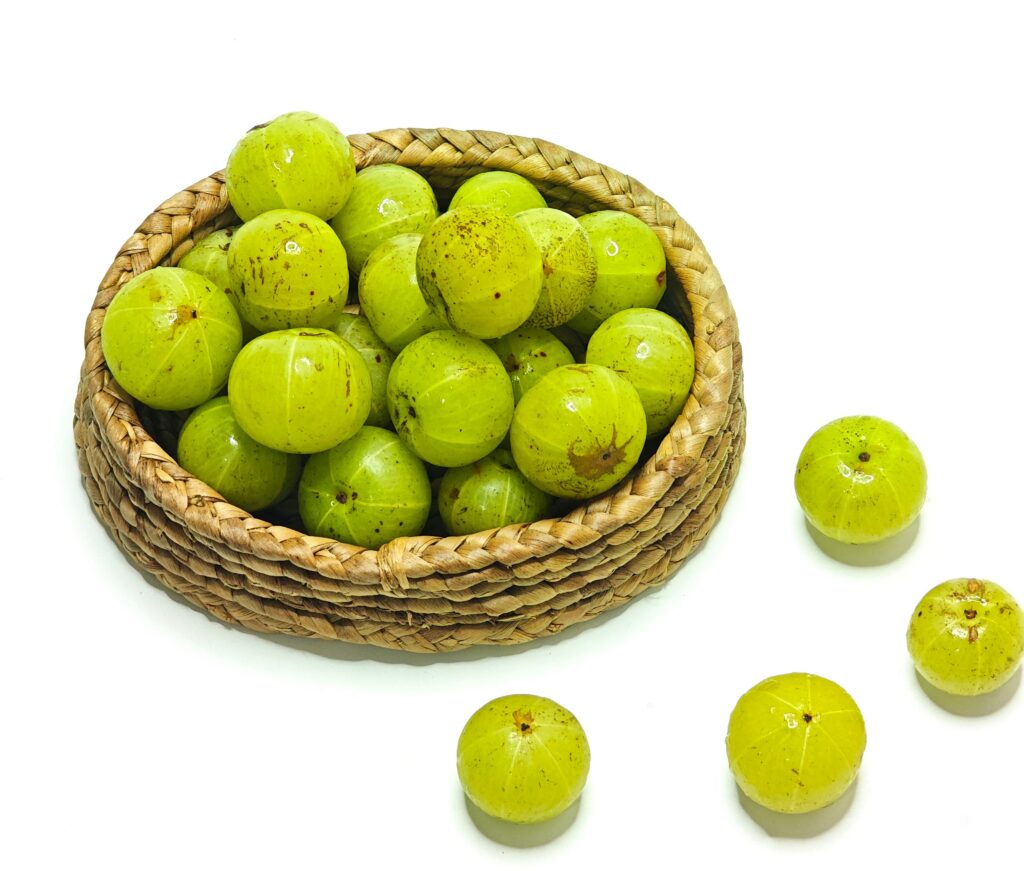
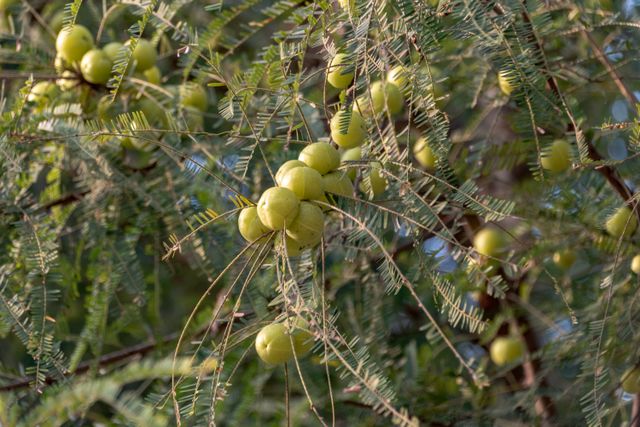
Amla, known as amalaki in Sanskrit and Indian gooseberry in English, is the fruit of Phyllanthus emblica L., also written Emblica officinalis. The tree is native to India and Southeast Asia. They are also found across China, Iran, and Pakistan 1. The fruit is small and round, roughly the size of a golf ball. They are also pale green and translucent, marked with faint vertical ridges. It is firm, fibrous, and startlingly sour.
Nutritionally, amla’s identity rests on two things working together: vitamin C and polyphenols. It is genuinely rich in ascorbic acid, and it carries a broad spectrum of protective plant compounds. Phenolic acids such as gallic acid and ellagic acid, flavonoids such as quercetin and kaempferol. A distinctive family of hydrolysable tannins including corilagin, geraniin, and pedunculagin 1. Alongside these it offers dietary fiber. Plus smaller amounts of minerals such as calcium and iron and vitamins A, B1, and E.1
About the Vitamin C Claim
You have almost certainly read that a single amla berry holds as much vitamin C as twenty oranges. It is a wonderful line. It is also more than the measured data supports, and amla is nutritionally interesting enough that it does not need the exaggeration.
Published analyses of different amla varieties report vitamin C somewhere between roughly 193 and 720 mg per 100 g of fruit. Depending on cultivar, ripeness, storage, and processing 1. That is still remarkable for a fruit. A single 100 g serving, two or three amla berries, would cover an adult’s daily vitamin C needs several times over 1. But it is a wide range rather than a fixed number. That's why it's fresh fruit, juice, powder, and standardized extracts should never be assumed to be nutritionally interchangeable.
There is a second, more fascinating reason those numbers vary. Amla’s own tannins interfere with the standard laboratory tests for vitamin C. Conventional methods have been shown to overestimate ascorbic acid in this fruit. Researchers later found it can be mistaken for other compounds present in amla during analysis 5. Some scientists have argued that amla holds very little free vitamin C at all. The antioxidant effects usually credited to the vitamin actually come from its tannins; others dispute the details 5. The debate is not settled.
What is not in dispute is the practical conclusion, the one Ayurveda arrived at long ago, and the one that guides how we formulate. Amla’s value is not one molecule. It is a whole fruit whose vitamin C and polyphenols work together. The tannins even seeming to protect the vitamin C from breaking down. That is the case for eating the fruit, not chasing a number on a label.
An Ancient Fruit, and the Sage Who Grew Young
The Charaka Samhita, one of Ayurveda’s foundational texts, compiled well over two thousand years ago, devotes an entire chapter to rasayana. The branch of the tradition concerned with rejuvenation, vitality, and long life.4 At the front of that chapter sits a story.
The sage Chyavana had grown old in the forest, frail and nearly blind. He had sat so long in meditation that white ants had built their mounds around him. In the version most often told, the young princess Sukanya became his wife. Then moved by his condition, appealed to the Ashwini Kumaras, the twin physicians of the gods. They prepared him a rich paste built around amalaki, folded together with honey, ghee, and a long list of supporting herbs. Chyavana emerged restored.
The preparation took his name. Chyavana plus prasha, is a specially prepared food. It gives us Chyawanprash, which is still made, still sold, and still eaten by the spoonful across India today. Often described as one of the oldest herbal formulations still in continuous use anywhere in the world, and amla remains its principal ingredient.4
It is a myth, of course, and worth holding as one. But the durable part is not the miracle. It is that a culture looked at this fruit — sour, common, growing on ordinary trees — and chose it as its emblem of renewal, then kept eating it for two thousand years. Traditions are not evidence. But a tradition that patient is worth listening to.
What do you return to, day after day, simply because it makes you feel more like yourself?
Amla in the Ayurvedic Tradition
Within Ayurveda, amalaki is counted among the foremost rasayana herbs. The word joins rasa (essence, or vital fluid) and ayana (path) — “the path of essence” — and refers broadly to nourishment and practices. They are meant to sustain the tissues, preserve vitality, and support aging well.4
Amla’s traditional profile is genuinely unusual:
- Rasa (taste): five of the six tastes. Sour above all, along with sweet, astringent, bitter, and mildly pungent. It lacks only salty.
- Virya (energy): cooling.
- Vipaka (post-digestive effect-sweet): which is precisely what you taste a moment after the sourness fades.
- Dosha: traditionally considered balancing to all three, with a particular affinity for calming Pitta, the fiery energy associated with heat.6
That combination, sour yet cooling, is what makes amla distinctive. Sour foods usually heat the body; amla is said to kindle agni, the digestive fire, without adding excess heat. It is traditionally associated with nourishing the tissues, maintaining ojas (the reserve of vitality and resilience). Also supporting digestion, elimination, the eyes, the skin, and aging well 6.
It is also one of the three fruits in Triphala (amalaki, bibhitaki, and haritaki). The classical blend long used for digestion and gentle cleansing 6. Triphala is one of the Ayurvedic herbs we carry into our Sita Protein. As always, these are traditional perspectives offered as context and wisdom, not as medical diagnoses or a substitute for care.
What Modern Research Is Exploring
Research on amla is active and genuinely promising. It is also worth being clear where it stands: much of it is laboratory or animal work, the human trials are few and often small. None of it should be read as established treatment evidence.
One of the more carefully designed human studies was a randomized. A double-blind, placebo-controlled crossover trial in which fifteen healthy adults took 500 mg of amla daily across eighteen weeks. Researchers reported improved blood fluidity. The study’s primary measure — along with reductions in several biomarkers of oxidative stress and improvements in HDL and LDL cholesterol. All with no adverse events observed 2. Fifteen people is a small group, and small studies suggest rather than establish. But it is a well-controlled look at a whole food, and it points somewhere worth following.
A 2017 study took the tradition at its word and tested Amalaki Rasayana, the classical amla preparation, in rats. Animals given it showed improved heart function as they aged. Reduced cardiac enlargement in an induced model, and longer time to fatigue on a treadmill 3. This is animal research, not evidence about people. But it is a striking example of modern laboratory methods pointed directly at a two-thousand-year-old formula and finding something worth measuring.
Zooming out, a 2022 review concluded that amla’s polyphenols and vitamin C confer meaningful antioxidant activity. Early findings across cardiovascular, metabolic, and digestive research are promising enough to warrant further work. All while stating plainly that stronger animal and human studies are still needed 1. That is the honest state of things: an ancient food, an interesting phytochemistry, encouraging early signals, and real research still to do.
Bringing Amla Into Daily Life
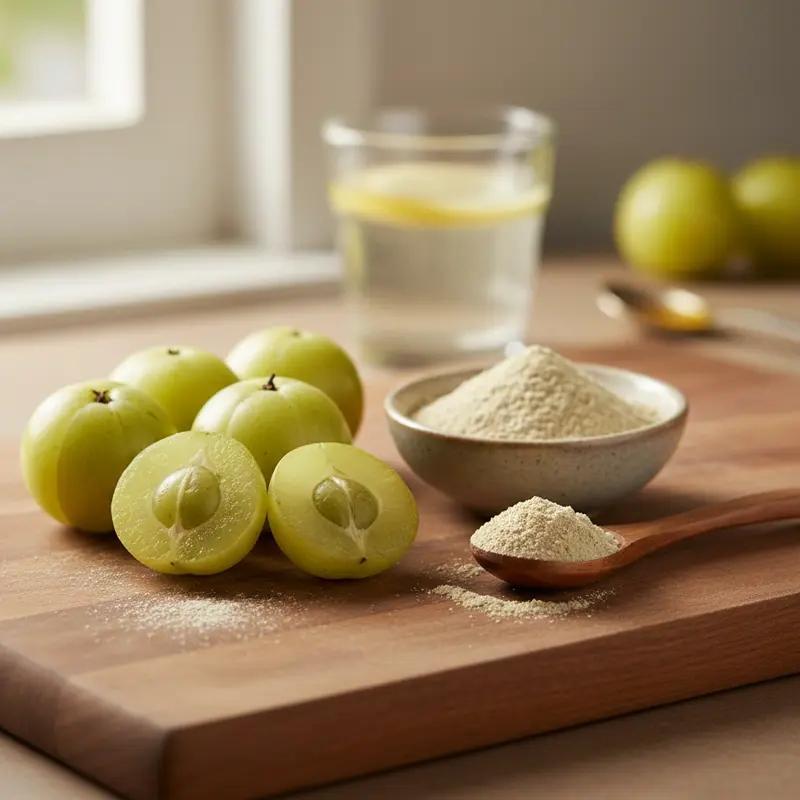
Fresh amla is difficult to find outside of India and, frankly, difficult to eat plain. Most people meet it in gentler forms. Sometimes dried and powdered, pressed into juice, folded into Chyawanprash, or included in a whole-food blend. The trick is to pair it with something sweet or creamy. A spoonful of powder disappears into a smoothie with banana or mango, or brightens a glass of water with honey much the way lemon does. In India it is candied, pickled, and simmered into murabba, all ways of softening the sourness without discarding the fruit.
If you would like the simplest version, our SuperFruit C combines amla with acerola cherry, camu camu, rosehips, and other vitamin C–rich fruits. All so a whole-food dose blends into water or a smoothie in seconds. And if the rasayana approach appeals to you, our Sita Protein carries Triphala — amla included — alongside hemp heart protein and Ayurvedic digestive spices.
Amla also invites a small moment of attention — the sourness is simply too loud to ignore. Notice how the taste moves: sharp at the front, then drying and astringent, then, if you wait, sweet. In a tradition that treats taste as information, that arc is the entire point.
Amla is generally well tolerated as a food. As a simple matter of care. If you are pregnant or nursing, taking medications — particularly blood thinners or medications for blood sugar — or preparing for surgery, check with a healthcare professional before adding concentrated amla to your routine.
Key Takeaways
- Amla (amalaki, Indian gooseberry) is a small sour fruit rich in vitamin C and antioxidant polyphenols — a combination that works together rather than as any single nutrient.
- Reported vitamin C varies widely, roughly 193–720 mg per 100 g, so fresh fruit, powder, juice, and extracts are not interchangeable.
- In Ayurveda, amalaki is a premier rasayana: cooling, balancing to all three doshas, especially calming to Pitta, traditionally used to nourish vitality and support healthy aging.
- It is the principal ingredient in Chyawanprash and one of the three fruits in Triphala.
- Modern research is promising but early, largely laboratory and animal work, with few human trials.
- Start gently: a spoonful of SuperFruit C or Sita Protein powder in a smoothie is the easiest way in.
A Quiet Kind of Renewal
Renewal is rarely dramatic. It tends to look like small things repeated. A little more rest, a little more care, one more nourishing choice made often enough that it stops feeling like a choice at all. Amla has been part of that pattern for a very long time. Not a cure, and not a miracle. Only a sour little fruit that people kept coming back to because it made them feel more like themselves. There is something quietly reassuring in that.
If you would like an easy way to bring amla into your day. Our SuperFruit C blends it with some of the most vitamin C–rich fruits on earth. Created to work in harmony with daily nourishment, movement, and rest. Or, if the rasayana path is the one that draws you, our Sita Protein carries Triphala alongside hemp heart protein and gentle digestive spices. And if this sparked something, share it with someone building their own quiet practice of renewal.
Don’t hesitate to reach out to us at care@sarvaaorganics.com for further guidance or to share your wellness journey. We’d love to hear from you.
Be Well,
Joshua and the Sarvaa Crew
Sources Cited
1 Gul, M., et al. (2022). “Functional and Nutraceutical Significance of Amla (Phyllanthus emblica L.): A Review.” Antioxidants 11 (5): 816.
2 Kapoor, M. P., et al. (2020). “Clinical Evaluation of Emblica officinalis Gaertn (Amla) in Healthy Human Subjects: Health Benefits and Safety Results from a Randomized, Double-Blind, Crossover Placebo-Controlled Study.” Contemporary Clinical Trials Communications 17: 100499.
3 Kumar, V., et al. (2017). “Amalaki Rasayana, a Traditional Indian Drug Enhances Cardiac Mitochondrial and Contractile Functions and Improves Cardiac Function in Rats with Hypertrophy.” Scientific Reports 7: 8588.
4 Charaka Samhita Online. “Rasayana Adhyaya.” Charaka Samhita, Chikitsa Sthana, Ch. 1. (Classical source for rasayana and the Chyawanprash origin narrative.)
5 Majeed, M., et al. “Ascorbic Acid and Tannins from Emblica officinalis Gaertn. Fruits — A Revisit.” Journal of Agricultural and Food Chemistry. (On the overestimation of ascorbic acid in amla by conventional assays.)
6 Banyan Botanicals. (n.d.). “Amla (Amalaki).” Traditional Ayurvedic perspective.
Disclaimer: Insights are based on nutritional science, naturopathic principles, Ayurveda, and traditional herbal practice. Ingredient benefits reflect historical use and modern research on nutritional composition. Educational use only. This information is not medical advice and is not intended to diagnose, treat, cure, or prevent any disease. Statements have not been evaluated by the FDA.